

Last Updated: October 30, 2026
Quick Summary
The best portable PA systems for small venues are sized to the room, the sources you plug in and how much setup you can handle. Match power to audience size with headroom to spare, pick full-range or column speakers for your use, and check that the mixer has every input type you need.
- Wattage describes amplifier drive, so size the system by audience capacity and room volume instead.
- For audiences up to 30, prioritize speech clarity, a low noise floor and easy carrying.
- Size the system so normal operating level sits well below maximum to avoid strain and clipping.
- Battery runtime should be checked at the volume you actually plan to use, not best-case figures.
- Count your mic, instrument, line and playback sources, and buy a system with a spare mic and line input.
Table of Contents
- What a Small-Venue Portable PA System Needs to Do
- Matching Power Output to Room Size and Audience
- Column and Full-Range Speaker Options for Small Rooms
- Battery-Powered PA Systems: Runtime and Power Planning
- Mixer Inputs, Microphones and Connectivity
- Portable PA System Setup for Bands, Presenters and Events
- Choosing Your Small-Venue PA System and Next Steps
- Frequently Asked Questions
Choosing a portable PA system for a small venue sounds simple until you start comparing wattage numbers, speaker sizes and battery claims. This buyer's guide from RedOne Music Canada walks through what actually matters when you are setting up for a band, a presenter or a small event, so you can pick a system that fits the room instead of overpaying for power you will never use.
What a Small-Venue Portable PA System Needs to Do
A portable PA system has one job: make the people in the room hear clearly without distortion. In a small venue, that job is easier than in a stadium, but it still depends on a few specifics.
Start with the room itself. A small bar, a café stage or a community hall has different acoustics from a large open space. Hard walls reflect sound, while soft furnishings absorb it. A system that sounds fine in a carpeted studio may feel harsh in a tiled room.
Next, consider the sources you need to amplify. A singer with one microphone has very different needs from a three-piece band with electric guitar, bass and a drum kit. Presenters often need only one or two microphones and clear speech reproduction, which is a different priority from full-range music.
Finally, think about who runs the setup. If you are the only person moving gear, weight and setup time matter more than peak loudness.
Matching Power Output to Room Size and Audience
Power is the number most buyers look at first, and it is also the number most often misread. Wattage describes how much the amplifier can drive, not how loud the speaker will sound in your room.
A more useful starting point is audience capacity and room volume. Refining these calculations often requires balancing raw output against the nuanced tonal characteristics detailed in our boutique amplifier guide for those seeking a more tailored sonic signature.
| Audience | Typical room | What to prioritize |
|---|---|---|
| Up to 30 | Café, small studio, meeting room | Speech clarity, low noise floor, easy carry |
| 30-75 | Small bar, community hall side room | Coverage pattern, headroom, one sub optional |
| 75-150 | Full bar, small hall, covered patio | Low-end support, dispersion, mixer channel count |
| 150+ | Large hall or outdoor event | System design, not a single box |
These bands assume amplified music with vocals and a rhythm section. For speech-only events, drop one row: a presenter addressing 100 people in a reverberant hall often needs less output than a four-piece band playing to 40.
Headroom matters more than the headline number. Running any speaker at its maximum for a full evening usually sounds strained, and compact systems compress noticeably as they approach their limit. A useful approach is to size the system so your normal operating level sits well below its maximum, so transients and peaks pass without clipping.
Sound pressure level is the spec that actually correlates with perceived loudness, but manufacturers quote it inconsistently. Some publish peak SPL at 1 m, others publish calculated maximum, and some publish neither. When a figure is given, ask whether it is peak or continuous and at what distance.
Finally, match the system to the material. A rock band with a live drummer needs low-end headroom that a solo acoustic act does not. A DJ set needs more subwoofer capability than a folk trio.
Column and Full-Range Speaker Options for Small Rooms
Small venues generally suit one of two speaker styles. Full-range speakers, sometimes called two-way or three-way designs, spread sound across the frequency range from one cabinet. They are simple to position and work well for mixed use, such as a band one night and speeches the next.
Column speakers are tall, narrow enclosures that project sound in a vertical pattern. They are often chosen for speech and background music because they cover a room evenly without the sound spilling onto the stage. Column designs can be a good fit for presenters in a church hall or a meeting room, although they usually lack the low-end punch that a live band needs.
A plug-in PA speaker generally outperforms a similarly sized battery-powered one in raw sound output. The trade-off is mobility, so weigh it against how often you will move the system.
Battery-Powered PA Systems: Runtime and Power Planning
Battery-powered systems remove the need to find a power outlet, which is valuable for outdoor events, busking-style setups or venues with limited electrical access. The cost is usually lower output and a finite runtime that depends on volume and load.
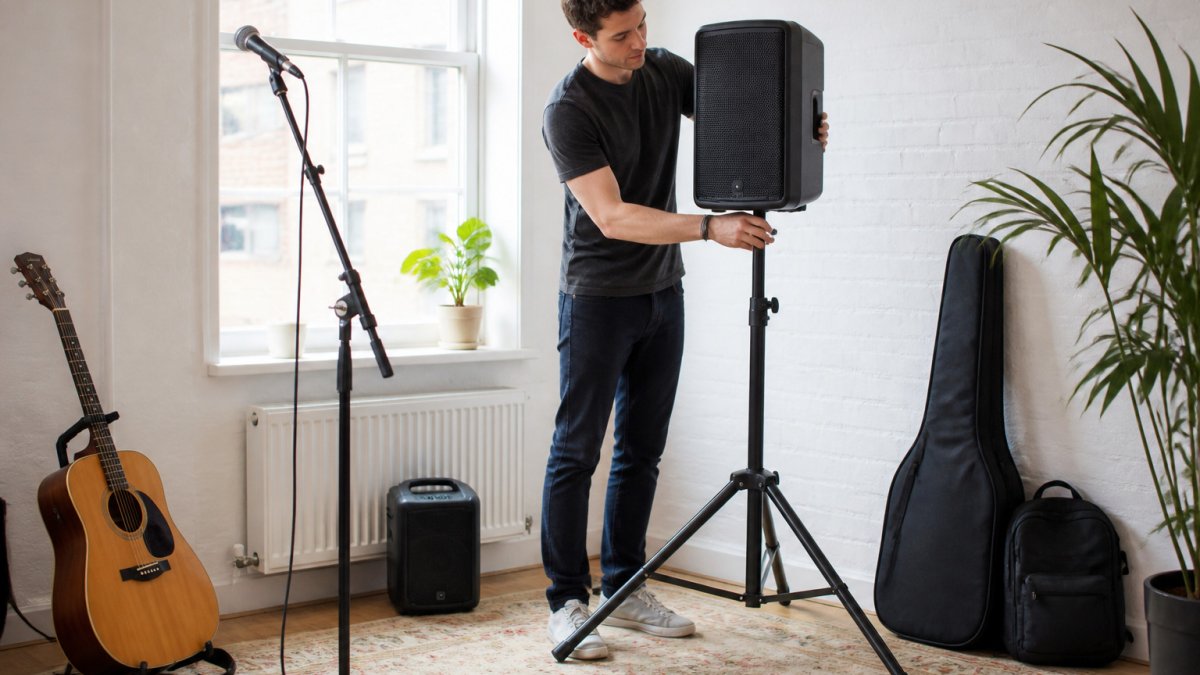
Before you buy, check the runtime at the volume you actually plan to use, not the best-case figure in the marketing. Louder playback drains the battery faster. Bring a power plan for longer events, whether that means a second battery, a charger that works on site or a backup plug-in option.
Buy Your First Acoustic Guitar →
Also confirm how the system charges and how long a full charge takes. A battery that needs an overnight charge is a problem if you play two shows in one day.
Mixer Inputs, Microphones and Connectivity
A speaker is only as useful as the signals you can feed into it. The right question is not "how many inputs?" but "which inputs, of which type, for which sources?" Map your typical setup to the list below before comparing systems.
Input types to check
- Mic inputs (XLR): needed for vocal mics, instrument mics and DI boxes. Confirm how many are true microphone preamps, not line inputs with an adapter.
- Phantom power: required for condenser microphones and many DI boxes. Not every compact PA provides it, and it is usually global rather than per-channel.
- Instrument inputs (Hi-Z / 1/4 in.): for electric guitar, bass and keyboards plugged in directly. A line-level input is not the same thing and will sound thin or quiet with a passive instrument.
- Stereo line inputs (1/4 in. or RCA): for backing tracks, a laptop, a media player or a second mixer.
- Bluetooth: convenient for walk-in music and backing tracks, but expect latency, fine for playback, poor for anything you need to play in time with.
- Aux / monitor send: lets a performer hear themselves through a separate monitor without changing the front-of-house mix. Useful for bands and optional for solo presenters.
- Record / stream output: useful for capturing the event or feeding a video call.
Match the mixer to the use case
| Use case | Minimum inputs | Features that matter |
|---|---|---|
| Solo singer with guitar | 2 (1 mic, 1 instrument) | Per-channel EQ, phantom power if using a condenser, simple reverb |
| Duo or trio with backing tracks | 4-6 | Stereo line input for playback, aux send for a monitor, Bluetooth for breaks |
| Four- to six-piece band | 8+ or a separate mixer | Enough mic preamps, aux sends, subwoofer output, channel mute |
| Presenter or panel | 2-4 mic inputs | Speech-friendly EQ, priority/ducking if available, phantom power for lavaliers |
| Fitness or instructor | 1-2 (headset mic + playback) | Headset mic compatibility, Bluetooth, long battery runtime |
A common mistake is buying a speaker with exactly the number of inputs you need today. One spare mic channel and one spare line input cost little at purchase and save a rental or a splitter later.
Wireless and connectivity
Wireless microphone systems are usually sold separately, and the receiver needs its own input or must share one. Check whether the system has a dedicated wireless input or whether you will be unplugging a wired mic to use it. If you are comparing compact synths with a built-in microphone input and vocoder as a reference point, see the Korg MICROKORGuXL+ Mini Keyboard Analog Synthesizer. For Bluetooth, confirm the codec and whether the system can pair while other inputs are active, some units mute other channels during pairing.
A note on mixers built into speakers
Most compact powered speakers include a basic mixer: gain, EQ, and sometimes reverb and a monitor send. These are adequate for solo and duo work. Bands typically outgrow them quickly and benefit from a small external mixer feeding a single input on the speaker, which also centralizes control and reduces cable runs.
Portable PA System Setup for Bands, Presenters and Events
Setup decides how the system sounds as much as the specification does. Place the speakers at ear height or slightly above, angled toward the audience. Keep them away from walls where possible, because reflections can muddy speech.
Set the gain on each input before the audience arrives, starting low and raising the level until the signal is strong without distorting. Walk the room during a sound check, since the spot where you stand may not represent the back row.
Keep feedback in mind. Microphones placed too close to the speakers can squeal, so position the mic and speaker to avoid pointing one at the other. Many gigging musicians find that a short rehearsal in the actual venue saves more trouble than any equipment upgrade.
Watch out: Do not let a cable run across the front of the audience area without taping it down or covering it. A trip hazard during a live event can cause injury and a sudden stop in the show.
Choosing Your Small-Venue PA System and Next Steps
The right portable PA system for a small venue comes down to four questions: how big is the room, what sources do you need to amplify, do you need battery power, and how much setup time can you accept. Answer those first, and most choices narrow quickly.
If you are unsure which combination fits your setup, RedOne Music Canada can help you compare options across our range of portable PA systems and related gear. Check our website for current stock and specifications, and contact our team for guidance on mixer inputs and connectivity before you commit to a purchase.
Frequently Asked Questions
What is the best portable PA system for a small venue?
The best choice depends on room size, the type of performance and how often the system will be moved. For small rooms, look for a compact full-range or column speaker with enough output for your audience, a built-in mixer with at least a few microphone and line inputs, and a sturdy stand or pole mount. RedOne Music Canada carries a range of portable PA options; check the product pages for current stock and specifications, and contact the team if you are unsure which system fits your room and performers.
How many watts do I need for a small venue PA system?
Wattage alone does not determine loudness, because speaker efficiency, coverage pattern and room acoustics all matter. As a starting point, consider the audience size and whether the sound is mainly speech or amplified music with drums. Speech in a small room often needs far less power than a loud band. Compare the rated output and maximum sound level of each model, and ask how the manufacturer measured them, since the figures are not always directly comparable.
Can a portable PA system handle live music and vocals?
Yes, many portable PA systems are designed for bands, singers and presenters together. Make sure the system has enough channels for each vocal microphone and instrument input, and that the mixer offers adequate gain and tone controls. For bands with drums or loud amplifiers, a system with more output and a subwoofer will generally handle the load better than a small single speaker.
Do I need a mixer with a portable PA system?
For most live performances, yes. A built-in or separate mixer lets you balance vocals, instruments and playback sources, and it provides the inputs you need for microphones and instruments. If you only use a single microphone for speeches, a speaker with a simple volume control may be enough. Check how many inputs you need before you buy, including any wireless microphone receivers or playback devices.
